
《Deconstructing the Pet Economy 》Series 04:Nearly 40% of Consumers Are Willing to Pay 20% More — for What Pet Products?

From functional to desirable, pet home furnishings are undergoing a structural upgrade.
《Deconstructing the Pet Economy》 is a research series authored by David Thomas, Director at FirstCapital Advisers, with research partner Wing Ho, Chief Administrative Officer at FirstCapital Advisers, applying a macro lens and data-driven analysis to systematically examine the structural transformation of the global pet industry.
Introduction: An Overlooked Consumer Signal
In 2026, the China International Furniture Fair (CIFF Guangzhou), in partnership with iResearch, released the 2026 White Paper on China's Pet Home Furnishings Industry Development Trends. One data point stood out with unusual force:
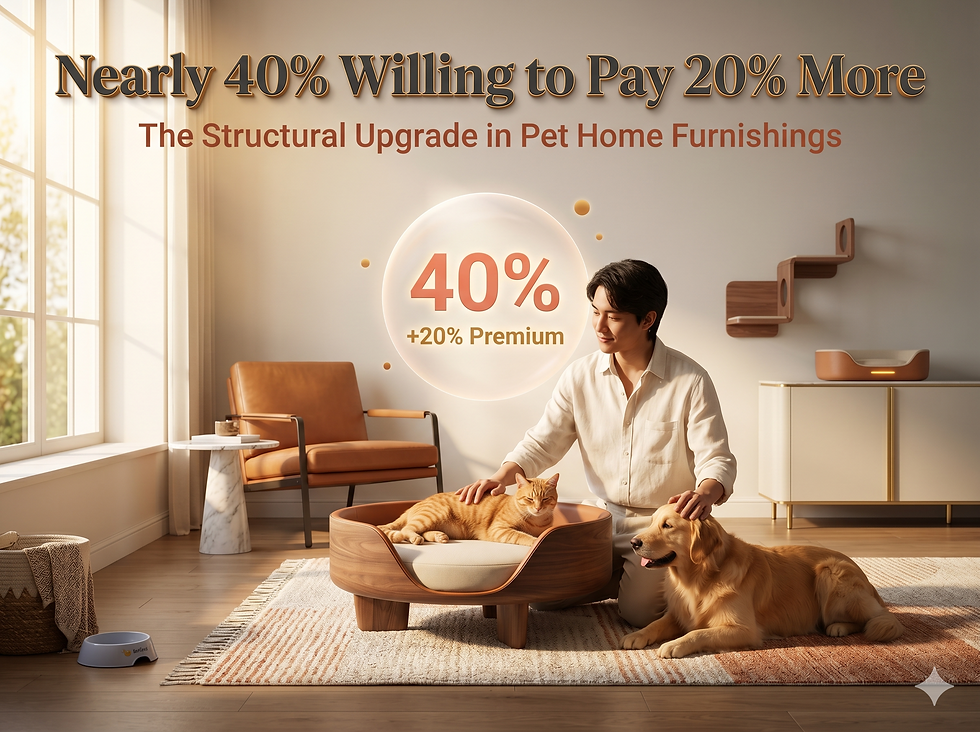
Nearly 40% of pet owners are willing to pay a premium of 20% or more for smart, space-efficient pet home furnishing products.
At a time when most consumer categories face downward pricing pressure, this is a rare signal. It suggests that a specific sub-sector within the pet economy is not only avoiding a race to the bottom — it is undergoing a structural shift from discretionary purchase to quality-driven essential.
A Longstanding "Either-Or" Dilemma
To grasp the value of this sub-sector, one must first recognise a critical market failure.
The pet supplies market has long been defined by a clear binary structure. On one side sit traditional pet brands: their products meet basic functional needs — durable, easy to clean, safe — but their design language, dominated by bright plastics and cartoonish forms, clashes with the minimalist, wood-toned, understated aesthetic of modern homes. On the other side are premium furniture brands: they command the discourse of home aesthetics, but their products were never designed to withstand claws, fur and stains.
Consumers have been forced into an unnecessary trade-off: choose functional products that disrupt the coherence of the home, or choose aesthetically pleasing items that cannot endure the realities of pet ownership.
This is not a niche complaint. China's urban pet (dog and cat) population has reached 126 million; approximately 95 million US households (66% of the total) own pets. Hundreds of millions of households worldwide confront the same daily question: how to live well with pets without compromising the comfort and aesthetics of the home.
A Multi-Billion-Dollar Segment Accelerating
Behind this "either-or" dilemma lies a global market in accelerating expansion.
According to Fortune Business Insights' 2026 report, the global pet furniture market was valued at US8.24 billion by 2034, representing a compound annual growth rate (CAGR) of 7.17%. North America accounts for 35.39% of the market.
More telling still, the design-integrated sub-segment is growing faster. Stratistics MRC research values the global pet-friendly home decor market at US20.57 billion by 2032 — a CAGR of 10.0%. A 10% CAGR in consumer goods qualifies as a high-growth segment and reflects a demand upgrade from "buy a piece of furniture for the pet" to "redesign the entire living space for human-pet cohabitation".
Modular pet furniture represents another fast-growing sub-category. Strategystics MRC data shows the global modular pet furniture market at US11.5 billion by 2032 at a CAGR of 6.5%. The research specifically notes that the core value of modular pet furniture lies in designs that "blend seamlessly with modern home décor" — a direct validation of consumers' strong demand for the integration of function and aesthetics.
China: On the Cusp of a Breakout
If the global market is accelerating, China's market is arguably on the cusp of a breakout.
The 2026 White Paper on China's Pet Home Furnishings Industry provides the critical data: in 2025, 22.6% of Chinese pet owners increased their spending on pet home furnishing products. In the online market, pet home furnishings accounted for 15.9% of total pet product sales, ranking as the second-largest category behind pet food, with year-on-year growth of 9.1%.
iResearch forecasts that China's pet consumption market will grow 9% year-on-year to RMB 340.8 billion in 2026, with the pet home economy demonstrating particularly strong growth momentum.
More significant from an investment standpoint is consumers' willingness to pay. The White Paper identifies three major trends:
Trend 1: Space efficiency first. Wall-mounted, modular and multi-functional integrated designs have become essential for pet owners in compact urban homes. Over 30% of users are willing to pay a 20%+ premium for high space utilisation.
Trend 2: Human-pet aesthetic integration. Over 60% of consumers favour integrated, concealed designs that blend seamlessly with their existing home décor. Pet home furnishings are moving from standalone items toward whole-home customisation, with category boundaries gradually dissolving.
Trend 3: Emotional ("dopamine") design. Products are evolving from functional tools into carriers of emotional value and social sharing appeal, using saturated colours, warm materials and endearing forms.
These three trends point to a single conclusion: pet home furnishings have transitioned from an optional extra to a quality essential for pet owners.
A Structural Gap on the Supply Side
The demand signals are clear. The supply-side response, however, has lagged.
Traditional pet brands remain constrained by functional inertia — their organisational capabilities and brand DNA make it difficult to break through in design language and home aesthetics. Home furnishing brands' forays into the pet sector remain largely extensions or pilots — Tmall data shows eight home furnishing brands crossed into the pet category in 2025, but none have fully committed to "human-pet cohabitation" as a core strategy. Meanwhile, emerging DTC brands, despite breakthroughs in design and branding, generally face challenges of shallow supply chains, limited retail coverage, and unproven scalability.
What the market lacks is not more pet furniture SKUs, but a brand integrator capable of genuinely unifying pet functionality expertise with home design aesthetics. This window — high growth, low brand saturation, absence of a category definer — is precisely where the structural opportunity lies.
A Rational Perspective: Reefs in the Blue Ocean
Any investment assessment requires a sober view of risk.
First, consumer education costs. "Pet home furnishings" as a standalone category has yet to be fully established in mainstream consumer consciousness. Most owners still habitually buy pet supplies in pet stores and furniture in home furnishing stores. The convergence of these two consumption scenarios will require time and marketing investment.
Second, the cross-disciplinary difficulty of supply chains. Factories that excel at pet products may not meet the craftsmanship standards, surface treatment capabilities or quality control systems required for home-grade manufacturing. Conversely, high-end furniture factories, with their procurement scale and cost structures, may not suit the retail pricing parameters of pet products. Balancing these two ends places heavy demands on supply chain integration capability. Having previously consulted in the furniture manufacturing space, we observe that real challenges emerge in supply chain configuration when manufacturers cross between large-scale volume production and bespoke small-batch manufacture — let alone attempting to combine distinct furniture categories from design and forecasting through to manufacturing and distribution. For a player to succeed in this cross-disciplinary space, the supply chain must be fit for purpose from the outset.
Third, the potential impact of economic cycles on non-essential goods. Although earlier articles in this series have established the overall counter-cyclical attributes of the pet economy, pet home furnishings — as a consumption-upgrade category — may face greater demand volatility in a significant recession compared with absolute staples like pet food.
Conclusion
When keeping a pet no longer means "making do", and when younger generations of owners refuse to choose between function and aesthetics, a structural market void is emerging.
The investment thesis for the pet home furnishings sector can be distilled into a single observation: at the intersection of two powerful long-cycle waves — pet humanisation and home consumption upgrading — a window of opportunity defined by high growth, low brand saturation and the absence of a category definer is opening. For investors focused on the consumer sector, this may be a sub-segment worthy of deeper examination.
Next up: Finding Blue Ocean in the Pet Sector — Why We Are Watching "Pet × Home"
Data Sources (in order of appearance):
CIFF Guangzhou & iResearch, 2026 White Paper on China's Pet Home Furnishings Industry Development Trends, May 2026
Fortune Business Insights, Pet Furniture Market Size, Share & Industry Analysis (2026-2034), March 2026
Stratistics MRC, Global Pet-Friendly Home Decor Market Forecasts to 2032, January 2026
Strategystics MRC, Global Modular Pet Furniture Market Forecasts to 2032, November 2025
PetData, 2026 China Pet Industry White Paper (Consumption Report)
iResearch, pet consumption market size forecast data
Tmall, 2025 Pet Economy Cross-Sector Observation Report
Data as at: May 2026
Disclaimer
This article has been prepared by FirstCapital Advisers based on publicly available information for industry research and discussion purposes only. It does not constitute investment advice, an offer, or a solicitation. References to third-party data and views do not constitute an endorsement of their accuracy, completeness or timeliness. Investors should conduct their own independent due diligence and thoroughly assess all relevant risks before making any investment decision. FirstCapital Advisers and its affiliates accept no liability for any loss arising from reliance on this content.


Comments