
From Competitiveness Rankings to Wealth Flows: Three Key Insights from the IMD World Competitiveness Yearbook 2026

On 18 June 2026, the International Institute for Management Development (IMD) released its World Competitiveness Yearbook 2026. Around the same time, the Boston Consulting Group (BCG) Global Wealth Report 2026 showed that Hong Kong had overtaken Switzerland as the world's largest cross-border wealth management hub, while Knight Frank's Wealth Report 2025 indicated that mainland China now ranks second globally with approximately 470,000 high-net-worth individuals.
These three reports appear independent at first glance, but they point to a single underlying trend: the flow of global wealth is reshaping the landscape of international competitiveness.
Core thesis: The IMD competitiveness ranking is not merely a league table—it is a "roadmap" of global wealth flows. Understanding it means understanding where capital is moving and where competitiveness is converging.
I. IMD 2026: Competitiveness Is No Longer Just About Cost and Scale
The IMD report assesses 70 economies across four core pillars—Economic Performance, Government Efficiency, Business Efficiency, and Infrastructure—drawing on 172 statistical indicators and a survey of 6,900 senior executives worldwide.
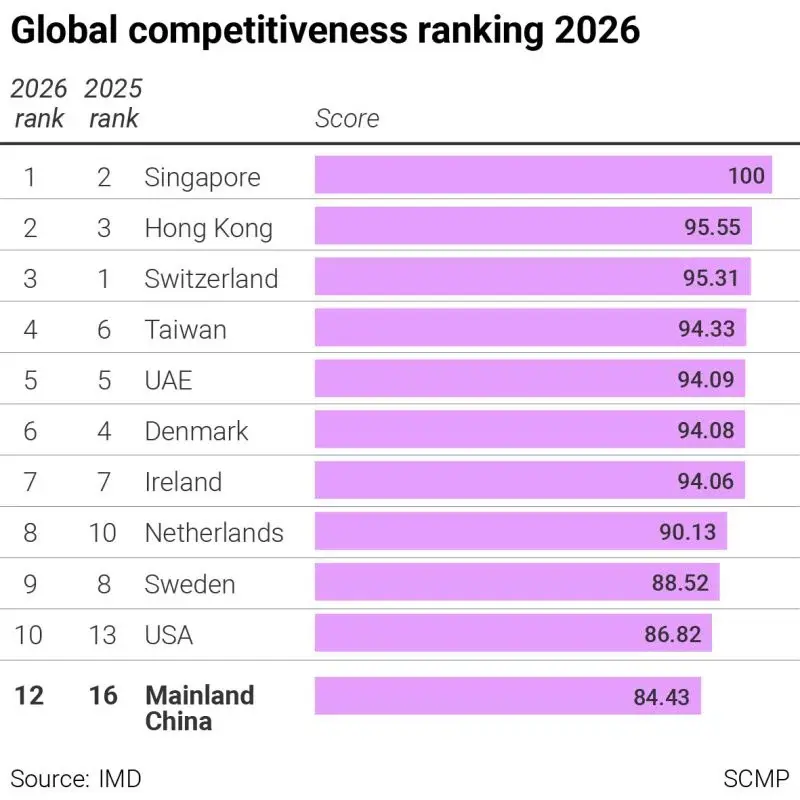
The top five rankings for 2026 are: Singapore, Hong Kong, Switzerland, Taiwan, and the United Arab Emirates. Mainland China rose from 16th to 12th place, while the United States returned to the top ten, ranking 10th.
Professor Arturo Bris, Director of the IMD World Competitiveness Center, observed:
"Geopolitical conditions are worsening, and global fragmentation is increasing. Nations with their own tried and tested, credible institutions gain an advantage in this context—because as international systems cease to serve so many national needs, businesses can carry on as usual."
The report's central conclusion is that competitiveness today is no longer primarily a contest of cost, scale, or even innovation—it is a contest of institutional credibility. The rule of law runs as a consistent theme throughout the report, enabling predictable policy implementation and credible economic signals.
II. Hong Kong: A Dual Validation of Competitiveness and Wealth Data
In the IMD rankings, Hong Kong moved up for the third consecutive year, rising from 3rd place in 2025 to 2nd place in 2026—its best result since 2019. "Government Efficiency" remained its defining competitive strength, holding 2nd place globally for the second straight year, while "Business Efficiency" ranked 3rd. Among sub-factors, "Tax Policy" and "Business Legislation" ranked 1st globally, "Finance" ranked 2nd, and "International Trade" and "International Investment" both ranked 3rd.
The Hong Kong SAR Government spokesperson noted that the ranking reflects the government's continued commitment to promoting a free, open, stable, predictable, and business-friendly economic policy framework, and demonstrates international confidence in Hong Kong's legal and regulatory environment.
These findings align closely with the BCG Global Wealth Report 2026. BCG reported that Hong Kong's cross-border wealth management assets grew 10.7% year-on-year in 2025 to USD 2.95 trillion, surpassing Switzerland's USD 2.94 trillion for the first time. The report attributed the growth primarily to capital inflows from the mainland, a vibrant IPO market, and equity market gains. BCG projects that Hong Kong's cross-border wealth will reach USD 4.6 trillion by 2030, growing at an annual rate of 9%.
The "institutional advantages" reflected in the competitiveness rankings are precisely the foundational reasons why wealth flows into Hong Kong. Hong Kong's clear tax regime, predictable regulatory environment, and free capital mobility—quantified in the IMD report as top-tier "Government Efficiency" and "Business Legislation"—are exactly what ultra-high-net-worth individuals and family offices look for when choosing a wealth hub. High-net-worth clients choose Hong Kong because it offers a more reliable and predictable form of security than traditional centres such as Switzerland—not an empty promise, but an institutional guarantee built on an independent legal system, free capital flows, a diverse product offering, and a clear and predictable tax framework.
III. Mainland China: Wealth Creation and Competitiveness Moving in Tandem
In the IMD report, mainland China rose from 16th to 12th place. IMD analysis indicates that despite some softening in economic performance, significant improvements in business efficiency—particularly in productivity, finance, and labour markets—along with gains in government efficiency, were key drivers of the rise. Professor Bris further noted that "China's domestic economic performance remains very strong, and from the perspective of productivity and labour markets, China stands out notably."
This is consistent with the Knight Frank Wealth Report 2025, which estimated that mainland China is now home to approximately 470,000 individuals with net assets exceeding USD 10 million, accounting for 20% of the global total and ranking second worldwide (behind only the United States). China's position as the world's second-largest wealth hub and its rising competitiveness ranking are two sides of the same coin—the concentration of wealth and the improvement in competitiveness both reflect the underlying strength of China as the world's second-largest economy.
For professionals serving high-net-worth individuals on the mainland, the IMD report offers a macro-level perspective: China's competitiveness improvement is driven not only by the scale of its economy, but also by tangible gains in business efficiency and productivity—providing a sustained macro-level tailwind for the wealth management industry.
IV. Switzerland: A Structural Link Between Competitiveness Decline and Wealth Outflows
Switzerland fell from 1st to 3rd place in the IMD rankings. The primary cause was a sharp deterioration in "Economic Performance," driven mainly by a severe decline in direct investment flows, compounded by a high-cost environment and negative long-term employment growth.
This mirrors the BCG data showing Switzerland being overtaken by Hong Kong. BCG reported 2025 cross-border wealth in Switzerland at USD 2.94 trillion, narrowly edged out by Hong Kong. BCG projects Swiss growth at 6% through 2030, with the gap to Hong Kong widening to approximately USD 600 billion.
BCG offered a sobering observation: "Geopolitical uncertainty reaffirms Switzerland's role as a core global booking centre, attracting flight-to-safety flows from more volatile regions, but it also exposes its vulnerability." In 2022, Switzerland broke with its longstanding neutrality to freeze Russian assets, followed by asset freezes on Venezuela, steadily eroding its reputation as a "neutral financial safe box." According to Swiss Bankers Association data, foreign clients withdrew CHF 108 billion from the Swiss banking system in 2024 alone.
Switzerland's competitiveness decline and wealth outflows are essentially the same story—an erosion of institutional credibility. The IMD report reveals the causes (investment outflows, deteriorating economic performance), while the BCG report shows the outcome (cross-border wealth overtaken by Hong Kong). Together, they point to a single conclusion: in an environment of rising geopolitical risk, "institutional trustworthiness" is being repriced.
V. Integrating the Trends: Three Reports, One Narrative
Looking at the three reports side by side, a clear picture emerges:
Report | Perspective | Key Findings | Common Theme |
IMD World Competitiveness Yearbook 2026 | Source of competitiveness | Global wealth and competitiveness shifting "Eastward" | |
BCG Global Wealth Report 2026 | Flow of wealth | Hong Kong USD 2.95 tn overtakes Switzerland USD 2.94 tn as world's largest cross-border wealth hub | |
Knight Frank Wealth Report 2025 | Creation of wealth | Mainland China 470,000 HNWIs, 20% of global total, ranking 2nd globally |
Where wealth flows, competitiveness follows; where competitiveness gathers, wealth gravitates.
The IMD report reminds us that in an increasingly fragmented world, "stability" and "trustworthiness" are the scarcest and most valuable assets of competitiveness. The BCG and Knight Frank reports provide the empirical evidence: global capital and wealth are voting with their feet.
For ultra-high-net-worth individuals in mainland China and the professionals who serve them, this trend points to three key takeaways:
Hong Kong's institutional strengths—clear tax policy, predictable regulation, free capital movement—have been quantitatively validated by the IMD report, providing a macro-level endorsement for wealth allocation to Hong Kong.
China's sustained competitiveness gains—improving business efficiency and productivity—offer fundamental support for continued domestic wealth creation.
Switzerland's loss of institutional credibility serves as a cautionary tale: in a rapidly changing global landscape, institutional credibility is not a permanent asset, but a fragile advantage that requires continuous maintenance.
In essence, the IMD report is not simply a ranking—it is an "underlying map" of global wealth flows. Understanding it means understanding where capital is heading and where competitive advantage is converging.


Comments