
《Deconstructing the Pet Economy 》Series 05: Finding Blue Ocean in the Pet Sector — Why We Are Watching "Pet × Home"

Excess returns in consumer investing often emerge from under-priced, cross-category intersections.
《Deconstructing the Pet Economy》 is a research series authored by David Thomas, Director at FirstCapital Advisers, with research partner Wing Ho, Chief Administrative Officer at FirstCapital Advisers, applying a macro lens and data-driven analysis to systematically examine the structural transformation of the global pet industry.

Introduction: Between Red Ocean and Blue Ocean
The pet food sector has become a red ocean. Leading brands control the majority of market share, price wars erupt regularly on e-commerce platforms, and the barriers to entry for new brands continue to rise. The pet healthcare sector carries deep moats and demands significant capital, but its return cycle is long.
Yet elsewhere on the pet economy map, a specific territory is quietly taking shape: one that is neither purely "pet supplies" nor purely "home design", but a deep convergence of the two — pet × home.
This is why we have returned repeatedly to this intersection throughout this series: it possesses nearly all the structural conditions required for an emerging blue ocean.
Defining "Pet × Home"
This cross-category is far broader than "pet furniture" alone.
It encompasses: pet beds, cat trees, pet mats, feeding bowls and other traditional pet furniture; scratch-resistant sofa covers, pet floor mats, pet gates and other home protection products; pet carriers, car seat covers and other travel accessories; and smart litter boxes, temperature-controlled pet beds and other technology-integrated products.
But these are merely category lists. What truly defines this space is not what is sold, but for whom it is designed. Traditional pet products are designed around the pet. "Pet × home" products are designed around the shared living space of humans and pets. This repositioning of the design centre brings with it a systemic upgrade in pricing logic, purchase frequency and user loyalty.
Three Structural Pillars of the Opportunity
We see three structural pillars underpinning the pet × home sector — pillars that, in our assessment, have yet to be fully priced in.
Pillar 1: The certainty of the supply-demand gap
In our previous article, we analysed in detail the longstanding "either-or" dilemma between pet supplies and home aesthetics — functional products that lack visual appeal, premium furniture that cannot withstand pets. This is not a marginal need; it is a daily reality for hundreds of millions of pet-owning households worldwide.
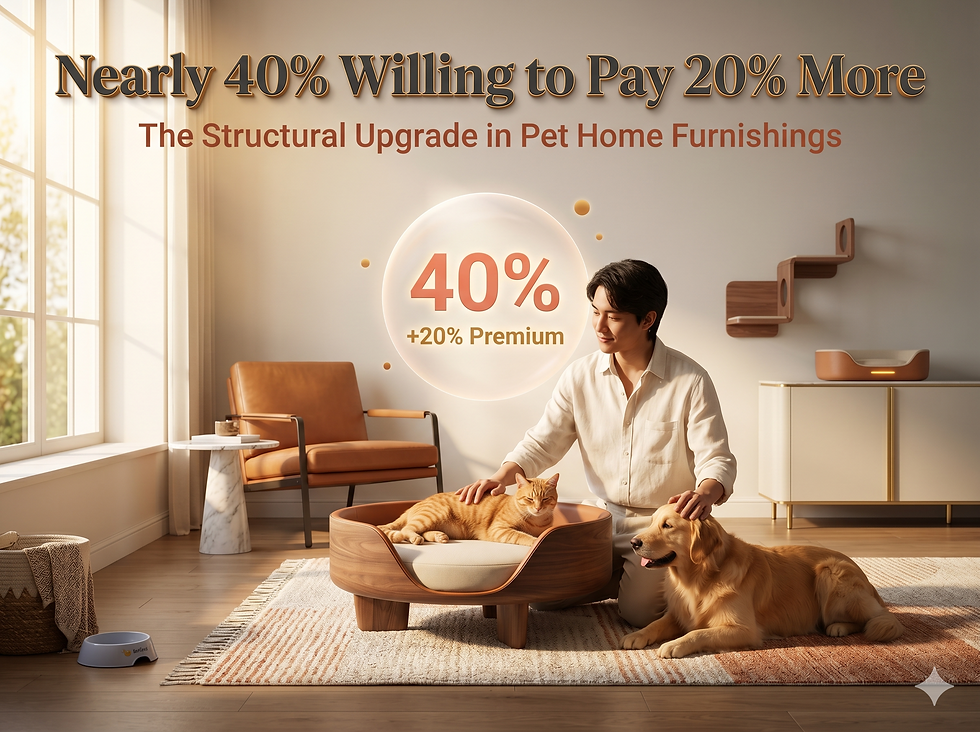
The 2026 White Paper on China's Pet Home Furnishings Industry Development Trends confirms the scale of this gap: over 60% of consumers favour integrated, concealed designs that blend seamlessly with their home décor; nearly 40% are willing to pay a 20%+ premium for smart, space-efficient products. Demand intent is clearly established, yet the supply side has yet to produce a brand that truly occupies the category's mindshare.
Pillar 2: The certainty of market expansion
The global pet furniture market stood at US8.24 billion by 2034, a CAGR of 7.17% (Fortune Business Insights). The related pet-friendly home decor market is currently valued at US$10.56 billion, with a CAGR of 10.0% (Stratistics MRC).
In China, pet home furnishings account for 15.9% of online pet product sales, ranking as the second-largest category, with year-on-year growth of 9.1% — outpacing pet food (White Paper). Given that China's pet-owning household penetration rate sits at just 22%, versus 66% in the US and 49% in Europe, the sustainability of this growth trajectory deserves close attention.
Pillar 3: The window of competitive opportunity
Current participants in this space can be broadly categorised into three types: traditional pet brands (strong on function, weak on design), home furnishing brands (strong on design, limited on pet-specific adaptation), and DTC startups (strong on branding, small in scale). No single player has yet established a clear category mindshare for "pet × home" in the consumer consciousness.
In consumer goods, the period during which category mindshare remains unclaimed is precisely the window of entry for a category definer. Once a brand becomes the first to occupy this position, the catch-up cost for late entrants rises considerably.
Why "Human-Pet Cohabitation" Is a Long-Term Trend
The pet × home sector is not a short-term fad because it is rooted in the convergence of two long-cycle trends.
First, pet humanisation is a generationally-driven, long-cycle trend. Post-90s and post-00s consumers have become the dominant pet-owning cohorts. They treat pets as family, and simultaneously regard their home environment as an extension of their personal aesthetic and lifestyle. They will not downgrade their living quality standards for the sake of pet ownership; rather, they want pets to become part of the home's aesthetic fabric.
Second, the compression of living space is an urbanisation-driven, long-cycle trend. Whether in Beijing, Shanghai, Shenzhen, Hong Kong, Tokyo or New York, per capita living space is more likely to tighten than expand for the foreseeable future. This drives rigid demand for multi-functional, modular, vertical-space-maximising pet home furnishing products.
The convergence of these two trends points in a single direction: the future growth of pet home furnishings is not a passing consumption wave, but a sustained consumption upgrade.
First Principles for Investors
From an investment perspective, the pet × home sector offers a distinctive combination: it simultaneously benefits from the counter-cyclical attributes of the pet economy (explored in Part 3 of this series) and the high-margin potential of home consumption upgrading.
More importantly, this sector remains in a pattern of "categories exist, brands do not." The history of consumer goods investing has repeatedly shown that once a category definer establishes first-mover advantage, it can convert category mindshare into sustained brand premium.
This is not to say that any venture entering this space is inherently investable. Quite the opposite: the critical questions are whether a company can genuinely solve the cross-disciplinary supply chain challenges, whether it can find a true equilibrium between pet functionality and home aesthetics, and whether it can build genuine omni-channel capabilities. These are the real filters.
In the final article of this series, we will provide a systematic framework for evaluating brands of this kind.
Final: An Investor's Checklist: Five Key Dimensions for Evaluating Pet Industry Startups
Data Sources (in order of appearance):
CIFF Guangzhou & iResearch, 2026 White Paper on China's Pet Home Furnishings Industry Development Trends, May 2026
Fortune Business Insights, Pet Furniture Market Size, Share & Industry Analysis (2026-2034), March 2026
Stratistics MRC, Global Pet-Friendly Home Decor Market Forecasts to 2032, January 2026
PetData, 2026 China Pet Industry White Paper (Consumption Report)
Data as at: May 2026
Disclaimer
This article has been prepared by FirstCapital Advisers based on publicly available information for industry research and discussion purposes only. It does not constitute investment advice, an offer, or a solicitation. References to third-party data and views do not constitute an endorsement of their accuracy, completeness or timeliness. Investors should conduct their own independent due diligence and thoroughly assess all relevant risks before making any investment decision. FirstCapital Advisers and its affiliates accept no liability for any loss arising from reliance on this content.

Comments