
Special Series: A New Paradigm for "Sino-Canadian" Investment in the Era of Global Resource Rivalry - Part II: Legal Logic

Part II: Legal Logic
Risk Hedging and Value Appreciation:
Legal Anchors and Compliance "Moats" in Canadian Resource Investment
【Connecting the Series】
In Part I, Macro Strategy, we explored the paradigm shift in "Sino-Canadian" resource layouts from "total control" to "flexible participation." However, amidst tightening regulation, how can capital ensure safety and certainty?
This article approaches the topic from a legal perspective, analyzing how Canada's mature legal system builds a compliance "moat" for cross-border capital, transforming policy challenges into institutional safeguards.

Macro View: An Asset Safe Haven in a Mature Legal Environment
Over the past twenty (20) years, Chinese capital has deployed $57.3 billion in Canada. As geopolitical volatility intensifies, there is a clear trend of high-net-worth capital returning to "high-certainty" regions. With its comprehensive common law architecture and stable foreign investment protection mechanisms, Canada has become an irreplaceable anchor for cross-border capital allocation.
Legal Protection: Building a Rigid Barrier for Cross-Border Investment
For professional investment institutions and high-net-worth individuals, the Canadian investment environment offers core legal pillars:
Deep Protection of Private Property Rights: The Canadian Constitution and provincial mining acts provide legal confirmation of resource development rights. Expropriation risk is extremely low, providing certainty for long-term asset appreciation.
Transparent and "Piercing" Regulation: Both the Investment Canada Act (ICA) and provincial resource regulations have highly transparent entry standards and approval timelines. Compliance costs can be accurately calculated before investment.
International Law Support via Bilateral Treaties: The existence of the China-Canada Foreign Investment Promotion and Protection Agreement (FIPA) provides capital with protection at the international law level, transcending local administrative regulations—a key chip in cross-border maneuvering.
Value Highlands: Structural Opportunities in LNG and Critical Minerals
Ensuring security is the foundation upon which the scarcity premium of Canadian resources is being redefined:
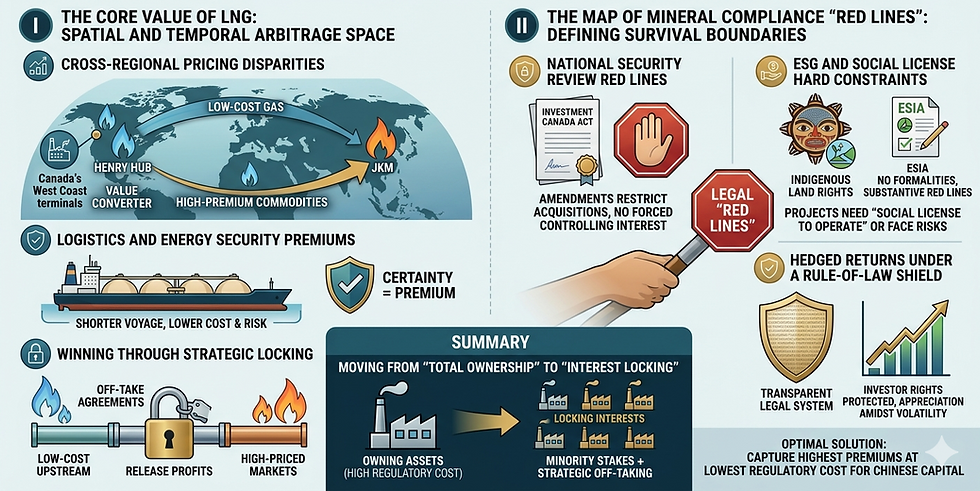
LNG as an Energy Security Anchor: West coast export terminals offer shorter-shipping routes and a lower carbon footprint, serving as a core path for Asia-Pacific energy diversification.
Strategic Value of Green Metals: As the upstream cornerstone of the global green transition, Canada’s lithium, nickel, and cobalt resources possess immense strategic premium space in the restructuring of global supply chains.
Conclusion:
Resolving Regulatory Costs through Structural Design
Faced with increasingly complex sectoral reviews, professional legal teams are utilizing structural designs such as minority investments and strategic Off-take Agreements.
This allows for the substantive locking of upstream resources without triggering major regulatory thresholds. This strategy of "light ownership, heavy interest" is becoming the mainstream paradigm for outbound investment today.

Comments