
Special Series: A New Paradigm for "Sino-Canadian" Investment in the Era of Global Resource Rivalry - Part III: Deep Insight

Part III: Deep Insight
Value Reassessment:
Global LNG Arbitrage Logic and the "Red Lines" of Mineral Compliance
【Strategic Implementation】
Through the Part I: Macro Strategy and Part II: Legal Logic outlined in the previous two installments , we have defined the boundaries of "security" and "trend." This final part of the series enters the realm of micro-operational reality: deeply analyzing the global arbitrage mechanisms of Liquefied Natural Gas (LNG) and precisely mapping the compliance "red lines" in mineral development. Our goal is to help investors transition from "owning assets" to "locking interests" amidst complex global competition.
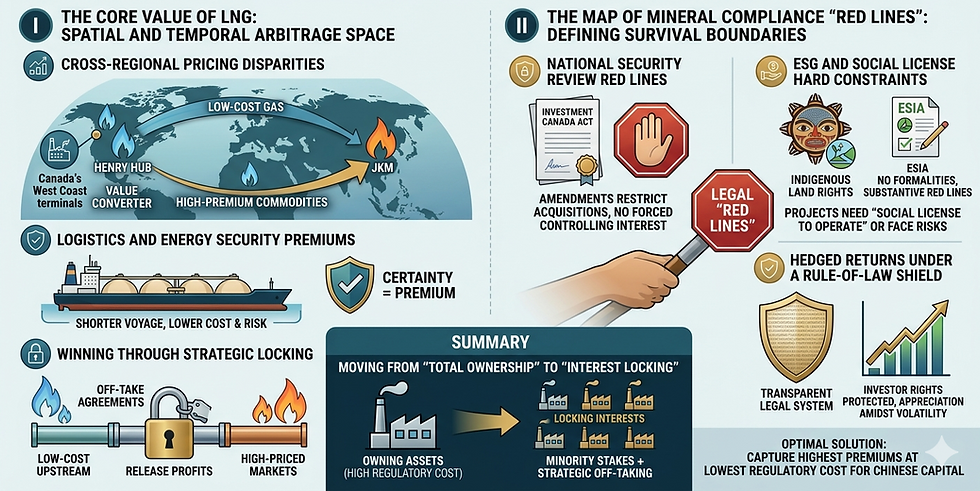
I. Global LNG Premiums: Structural Dividends of Cross-Regional Arbitrage
The core value of LNG lies not just in the molecule itself, but in its "spatial and temporal arbitrage space."
Cross-Regional Pricing Disparities: The North American benchmark (Henry Hub) remains low due to abundant supply, while the Asian market (JKM) commands a significant premium. The strategic significance of Canada’s West Coast terminals lies in their role as "value converters," turning low-cost gas into high-premium global commodities.
Logistics and Energy Security Premiums: West Coast export terminals possess a natural geographical advantage. Shorter voyages mean lower-logistical costs and risks. In an era where the weight of energy security is rising, this certainty itself constitutes a premium.
Winning through Strategic Locking: Locking in low-cost upstream resources through strategic Off-take Agreements and releasing profits in high-priced terminal markets is the core logic of current energy arbitrage.
II. The Map of Mineral Compliance "Red Lines": Defining the Survival Boundaries
Faced with high-premium temptations, clearly identifying legal "red lines" is the prerequisite for investment security.
National Security Review Red Lines: Amendments to the Investment Canada Act, particularly restrictions in the critical minerals sector, have drawn a clear political boundary. The era of forced controlling-interest acquisitions has ended.
ESG and Social License Hard Constraints: In Canada, Indigenous land rights and Environmental and Social Impact Assessments (ESIA) are not procedural formalities but substantive compliance red lines. Projects failing to obtain "Social License to Operate" from local communities face unpredictable risks of indefinite stagnation.
Hedged Returns under a Rule-of-Law Shield: Despite increasing red lines, Canada’s transparent legal system ensures that as long as one operates within those lines, investor rights are rigorously protected, maintaining appreciation amidst global volatility.
Summary:
Moving from "Total Ownership" to "Interest Locking"
In a new era intertwined with resources, compliance, and maneuvering, the investor's logic must evolve from "owning assets" to "locking interests".
Through the flexible layout of "minority stakes + strategic off-taking," investors can capture the highest resource premiums in the global market at the lowest regulatory cost. This is the optimal solution for Chinese capital participating in Sino-Canadian investment today.


Comments