
Extended Reading: From "Resource Warehouse" to "Innovation Powerhouse" – Canada's Underappreciated Investment Dimension


The first three articles in this series examined the paradigm shift in “Sino-Canadian” resource investment—from "total control" to "flexible participation"—through the lenses of macro strategy, legal logic, and operational reality. Yet a sharp observation from a reader reminds us that if we fixate solely on Canada’s subsurface resources while ignoring its above-ground innovation and its sophisticated equilibrium among energy, industry, and ecology, we are missing at least half of the investment thesis. This article serves as an extension, aiming to fill that gap.
For a long time, Chinese investors have anchored their perception of Canada to one word: resources. Oil sands, LNG, lithium, nickel, cobalt. That characterization is accurate, but incomplete. Zoom out, and a more multidimensional Canada comes into focus.
It is both a "technology high ground" powering the industries of the future and one of the rare economies that operates energy security, industrial competitiveness, and ecological responsibility within a single institutional framework.
This composite capability—resources plus technology plus governance—delivers exactly what cross-border capital craves in an era of de-globalization, supply chain restructuring, and tightening ESG regulation: a source of certainty.
I. More Than a Resource Exporter: A Proving Ground for Frontier Technologies
For Chinese capital seeking an advantageous position in the global green supply chain, Canada’s most undervalued attribute is its original innovation capacity in artificial intelligence, quantum computing, and clean technology.
Quantum Computing: From Foundational Research to Industrial Closure
Canada has quietly cultivated its quantum computing sector for over two decades, with cumulative federal investment exceeding CAD 2 billion. The National Quantum Strategy, launched in 2023, allocated CAD 360 million specifically to post-quantum cryptography, quantum sensing, and quantum communications—areas intimately linked to defence and national security.
More symbolically, on March 27, 2026, Xanadu listed on the Nasdaq and Toronto Stock Exchange (ticker: XNDU), becoming the world’s first publicly traded pure-play photonic quantum computing company, with a valuation of approximately USD 3.6 billion and fresh capital of roughly USD 302 million. Xanadu’s open-source quantum software platform, PennyLane, is already adopted by global industrial players such as Lockheed Martin, AMD, Volkswagen, and Toyota, demonstrating that Canadian quantum technology has moved from the laboratory into industrial collaboration networks.
Meanwhile, in March 2026, the federal government committed CAD 50 million to a new Defence Innovation Security Centre, prioritizing quantum and unmanned systems. These investments send an unambiguous signal: Canada regards quantum capability as an asset of technological sovereignty.
For Chinese investors, this represents a distinct class of "technology mining"—one that does not carry the heavy environmental liabilities or geopolitical scrutiny of traditional extractive projects, yet can be accessed through minority equity investments, joint R&D, or licensing agreements. This aligns perfectly with the "asset-light, interest-heavy" strategy advocated throughout this series.
Artificial Intelligence and Clean Technology: Deep Academic and Industrial Ecosystems
Canada hosts world-leading AI research institutes—Montreal’s Mila, Toronto’s Vector Institute, Edmonton’s Amii—and maintains a front-line position in carbon capture, utilization and storage (CCUS), hydrogen, and small modular reactors. Svante, for instance, has deployed its solid-sorbent carbon capture technology at industrial scale across the oil and gas, cement, and pulp and paper sectors. These are not laboratory curiosities; in 2023, the clean technology sector contributed CAD 40.6 billion to GDP and supported over 224,000 jobs (the latest available official statistics).
This closed-loop ecosystem means that partnerships with Canadian firms can generate genuine technology spill-overs rather than mere resource imports.
II. The “Triangular Balance” of Energy, Industry, and Ecology:
A Codified Operating Reality
In many emerging markets, "sustainable development" and "green growth" are aspirational slogans. In Canada, they constitute a legally embedded, quantifiable, and enforceable set of constraints. Importantly, this regime is itself emerging as both a quality filter for projects and a trust mark that attracts responsible capital.
The Institutional Loop of Carbon Pricing and Clean Investment Tax Credits
Canada enforces a stringent federal carbon pricing benchmark; every province must meet a minimum level of stringency, and industrial emitters bear a real cost for their carbon emissions.
On the flip side, the government directs capital toward clean activities through tax instruments. A milestone was reached on March 26, 2026, when Bill C-15 (Budget Implementation Act, 2025, No. 1) received royal assent, cementing several clean economy investment tax credits into law. Notably, the full-rate eligibility period for the CCUS investment tax credit was extended from 2030 to 2035; the clean technology manufacturing investment tax credit was expanded to cover polymetallic mining equipment and strategic minerals such as antimony, indium, gallium, and germanium; and the clean hydrogen investment tax credit was broadened to include methane pyrolysis projects.
This sequence of actions conveys a clear logic: Canada is not "subsidizing green" as much as it is pricing pollution while simultaneously rewarding decarbonization. For professional institutions with ESG mandates, such unambiguous pricing signals reduce regulatory uncertainty and enable more reliable return calculations for long-duration capital expenditure decisions.
Circular Economy and Urban Mining in Critical Minerals
Canada’s embrace of circular economy principles in critical mineral development is perhaps the purest illustration of the energy-industry-ecology equilibrium.
Ontario has pioneered a Recovery of Minerals regulatory framework, allowing mine waste rock and tailings to be reprocessed—turning yesterday’s solid waste into tomorrow’s mineral feed.
Quebec’s 2025–2031 Critical Minerals Strategy dedicates CAD 88.1 million to strengthening mineral processing, recycling, and circular economy integration. At the federal level, Natural Resources Canada has invested CAD 9.1 million in Cyclic Materials, a company developing advanced rare-earth element recycling technology that extracts rare earths from end-of-life permanent magnets, marking the commercialization of “urban mining” for critical minerals.
This thinking is instructive for Chinese enterprises: rather than competing for sensitive mining concessions, they could participate in Canada’s “second mine” value chain—tailings reprocessing, urban recycling—through technology partnerships, equipment supply, or joint ventures. Such projects typically carry manageable environmental risk, enjoy higher community acceptance, and fall outside the sensitive perimeter of national security review.
Sustainable Investment Taxonomy and Social Licence
Canada is developing a Sustainable Investment Taxonomy, with the first three industry standards expected by the end of 2026, to provide a scientifically credible basis for defining “green” and “transition” activities. This is exactly the common language that ESG investors urgently need.
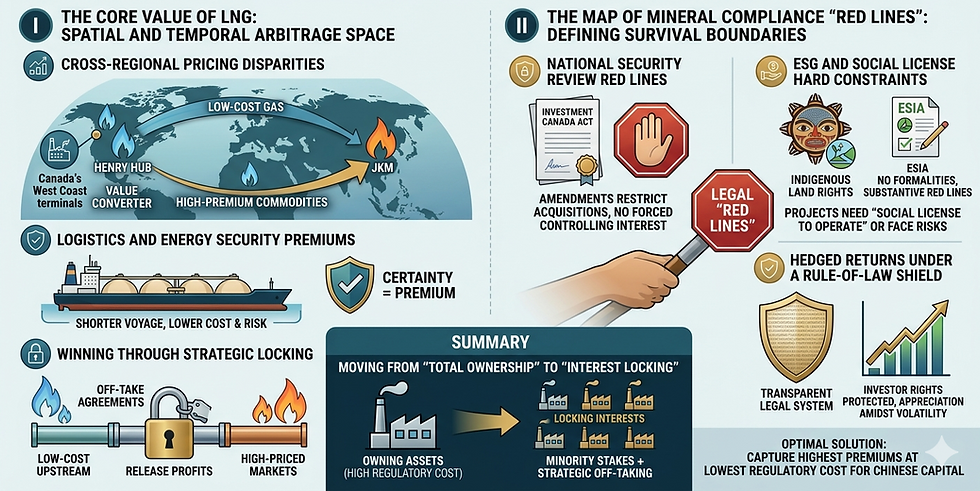
Simultaneously, Indigenous rights and community “social licence” are not optional public-relations exercises but substantive compliance red lines. Projects that operate soundly within this framework possess, by construction, higher resilience and long-term value.
III. New Implications for Sino-Canadian Investment:
Capturing the “Technology + Governance” Premium
Returning to this series’ central question—how Chinese capital can participate in Canadian opportunities amid a complex geopolitical landscape—the analysis above points to a more sophisticated “asset-light, interest-heavy” playbook:
From “buying mines” to “buying technology”: Strategically invest in small- and medium-sized Canadian clean-tech or quantum firms, acquiring minority stakes in exchange for IP sharing, Asia-Pacific market licensing, or joint R&D programs. This structure rarely triggers regulatory red flags.
From “controlling” to “embedding”: In critical minerals, pursue offtake agreements to lock in production rather than controlling ownership, while simultaneously offering Canadian partners Chinese strengths in processing and equipment manufacturing. The result is an upstream-downstream complementary joint venture that remains asset-light.
Convert compliance costs into brand premiums: Proactively align with Canada’s taxonomy and carbon pricing disclosure standards. Publicly reporting against these benchmarks sends a powerful signal to premium end-markets in Europe, Japan, and Korea that your product carries a verifiable “low-carbon footprint” and “responsible sourcing” pedigree.
Conclusion:
Access Code for Investing in Canada
In an era when global capital is searching for "certainty," Canada’s identity deserves to be redefined. It is not merely a global resource stabilizer; it is an incubator of future industries and a governance laboratory where energy, industry, and ecology are held in deliberate, law-bound balance.
For Chinese capital, fully understanding and leveraging these composite advantages — technological innovation, institutional transparency, and sustainability governance — is the true “access code” for investing in this country. Fixate only on the minerals beneath the ground, and you will miss the light above it.


Comments